


Ignite Off! fan favorite gains hands-on experience in applied food safety research through USDA fellowship
Meet Sheetal Jha

Sheetal Jha’s passion for food safety led her to an ORISE fellowship with the U.S. Department of Agriculture’s (USDA) Food Safety and Inspection Service (FSIS), where she studied meat-contaminated surfaces. (Photo credit: Dr. Isabel Walls, Acting Chief Scientist, Office of Public Health Science, USDA FSIS)
Sheetal Jha joined the U.S. Department of Agriculture (USDA)’s Food Safety and Inspection Service’s (FSIS) Food Safety Fellowship Program through the Oak Ridge Institute for Science and Education (ORISE) after learning about it from friends who shared their great experiences in the program. Jha, who’s always had a passion for science, especially food science, knew becoming a USDA FSIS fellow would help her follow those passions.
Under the guidance of her USDA FSIS mentor, Isabel Walls, Ph.D., Jha is learning methods to reduce Listeria monocytogenes and Salmonella contamination on surfaces, as well as gaining insight into FSIS programs and procedures. One of her most exciting moments was visiting a poultry processing facility in Athens, Georgia. Jha, a doctoral student at Louisiana State University, also participated in the 2025 ORISE Ignite Off! competition, where her presentation won fan favorite.
In this Q&A spotlight, Jha talks about her experience as an ORISE fellow and how it has shaped her confidence and professional identity in the field of food safety.
Tell us a little bit about your backstory and what motivated you to pursue a STEM career.
Science has fascinated me since childhood, which led me to study pharmaceutical technology, working closely toward formulation. Over time, I realized my passion for food science, specifically food safety, where I could apply microbiology to real-world challenges like food safety and pathogen control. Transitioning fields wasn’t easy, but my drive to explore this new domain kept me moving forward.
How did you hear about ORISE programs/opportunities, and why did you apply?
I first heard about the ORISE programs through friends who participated last year and had great experiences. They spoke highly of the hands-on research, mentorship and the opportunity to collaborate on real-world scientific challenges. Their experiences motivated me to apply, as I saw ORISE as a unique platform to deepen my skills in food safety research and contribute meaningfully to public health initiatives.
What was the focus of your fellowship, and what kind of projects were you involved in?
The focus of my fellowship was to improve food safety within meat processing environments by evaluating the effectiveness of antimicrobial treatments in reducing Salmonella and Listeria monocytogenes contamination on meat contact surfaces. Since these are major foodborne pathogens linked to meat and poultry, the aim was to identify key risk factors and assess natural intervention strategies to help mitigate contamination and enhance safety across the production chain.
What skills or knowledge did you gain during your fellowship?
During my fellowship, I developed skills in sample collection, microbial enumeration and assessing Salmonella contamination on food-contact surfaces. I also became familiar with USDA FSIS laboratory methods and regulatory protocols and the practical application of antimicrobial interventions under real processing conditions.
A key highlight was visiting a poultry processing facility in Athens, Georgia—my first time inside such a facility. It was a valuable experience that provided a real-world perspective on the complexity of food safety operations and sanitation practices.
Beyond lab and field research, the fellowship enhanced my skills in time management, teamwork and scientific communication in regulatory settings. Overall, this experience has significantly broadened my understanding of applied food safety, strengthened my technical foundation and reinforced my commitment to contributing to public health through microbiological research and science-based interventions.
During your ORISE appointment, what professional development events or activities did you participate in that added value to your experience?
During my ORISE appointment, I had the opportunity to participate in several professional development activities that enriched my experience and strengthened my scientific communication skills. One of the highlights was the ORISE Ignite Off! competition, where I presented my fellowship research in a concise and engaging format. With guidance from my mentors, I refined my presentation, “Bacteriocins at Work for Safer Food,” and was honored to receive the Fan Favorite award—an experience that deepened my appreciation for communicating science to diverse audiences.
Additionally, I presented my research at the International Association for Food Protection (IAFP) Annual Meeting, where I competed in the Developing Scientist Poster Competition and was awarded first place. This was a significant milestone in sharing my research with leading experts in food safety.
I also participated in the 3-Minute Thesis competition hosted by the Indian Association for Food Protection in North America, where I was thrilled to receive the Audience Choice Award. These experiences not only helped me grow as a researcher but also enhanced my ability to communicate complex scientific ideas effectively to both technical and non-technical audiences. They have been instrumental in shaping my confidence and professional identity in the field of food safety.
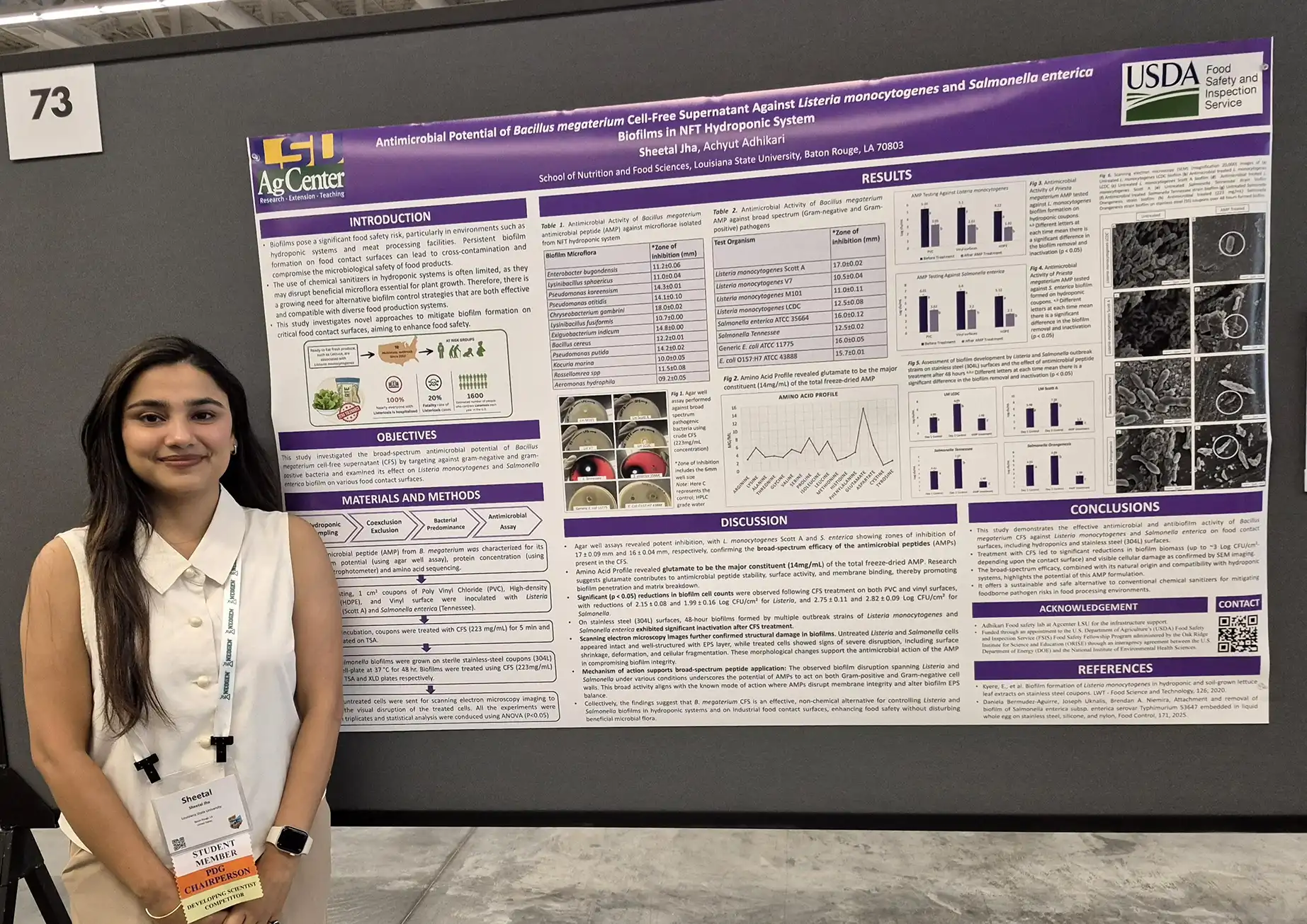
Jha presenting her research at the International Association for Food Protection as a part of her fellowship. (Photo Credit: Dr. Isabel Walls, Acting Chief Scientist, Office of Public Health Science, USDA FSIS)
What was the most rewarding or exciting part of your fellowship experience?
The most rewarding part of my fellowship was to regularly meet with my mentors virtually and learn from their experiences. The mentorship I received throughout the fellowship was invaluable and played a key role in shaping my professional growth. Another important point was seeing the real-world impact of food safety research, especially during my first visit to a poultry processing facility. Presenting my research at the IAFP Annual Meeting and winning first place in the Developing Scientist Poster Competition was a proud achievement.
Were there challenges you faced during this experience? How did you overcome those?
I did face several challenges during my fellowship, especially with experiments that didn’t produce the expected results. There were multiple failed trials, which at times felt discouraging. However, my mentors played a critical role in helping me navigate those setbacks. Instead of focusing solely on the outcomes, they recognized the effort behind each attempt and emphasized the value of learning through failure. Their encouragement helped me stay motivated, refine my methods and think more critically about my approach. They consistently pushed me to keep exploring, which ultimately strengthened both my resilience and problem-solving skills. This support made a significant difference and turned those challenges into opportunities for growth.
How do you see this fellowship shaping your future career or academic goals? What are your long-term aspirations in the STEM field?
This fellowship has played a significant role in shaping my future career goals by giving me hands-on experience in applied food safety research and exposing me to real-world challenges in public health. It has strengthened my interest in microbiology and pathogen control and confirmed my desire to pursue advanced research focused on sustainable food safety solutions.
Long-term, I aspire to contribute to the development of science-based interventions that reduce foodborne illnesses and improve global food systems. Whether through academic research or collaborating with regulatory agencies or industry, I aim to bridge the gap between scientific discovery and public health application—making food safer, more sustainable and accessible. This experience has laid a strong foundation for that path.
Looking back on your experience, how would you describe the overall impact and benefits of participating in this program, both personally and professionally?
Looking back, this fellowship has had a profound impact on me both personally and professionally. I learned that a failed experiment or a negative result is still valuable and worth reporting—it’s part of the scientific process, not a setback. This mindset shift helped me stay focused and resilient, even when things didn’t go as planned. My mentors encouraged this perspective and supported me through troubleshooting, which became one of the most rewarding learning experiences.
On a personal level, I learned that it’s OK to pause and regroup when facing challenges. Whether it's in the lab or in life, taking a step back, reflecting and returning with renewed energy can make a big difference. This experience taught me how to manage setbacks with clarity and continue moving forward with the same passion and purpose.
What can you share about yourself outside of your academic and professional journey? Any hobbies or interests, favorite activities, hidden talents, or memorable experiences — like trips you’ve taken or dream of taking — that might surprise or inspire your peers?
Outside of my academic and professional life, I’m a proud plant parent—I genuinely enjoy growing and caring for my plants. It brings me a sense of calm and serves as a daily reminder of patience and care. I also cherish spending time talking with my family back home and making the most of weekends with friends and loved ones.
Over the past year, I have discovered a deep appreciation for the outdoors, especially through camping. Escaping into nature has helped me disconnect from daily stressors and reconnect with the world around me. It’s become one of my favorite ways to recharge and has rekindled my love for the natural world.
In the future, I hope to explore Europe, especially by visiting the Eiffel Tower in Paris. Experiencing the region’s rich cultures, scenic landscapes and deep history is a dream I’m truly excited to pursue. Standing beneath the Eiffel Tower would be a moment of inspiration, especially as someone passionate about discovery and innovation.
From the ORISE Featurecast: Research into reducing food-borne illnesses: A conversation with Sheetal Jha, ORISE research program participant
Imagine using a protein from bacteria as a cleaning solution to reduce or eliminate food borne illnesses. That's the research Sheetal Jha conducted as an ORISE research program participant at the United States Department of Agriculture Agricultural Research Service. Jha is pursuing her doctoral degree at Louisiana State University and her ORISE appointment ended in October 2025. Her presentation on bacteriocins and safer foods was named Fan Favorite at the 2025 ORISE Ignite Off! competition. Jah completed her undergraduate and graduate studies in India with a focus on pharmaceuticals, but her interest in public health, safety and food science served as a bridge to her current research focus.
The USDA FSIS Food Safety Fellowship Program is funded by USDA FSIS and is administered through the U.S. Department of Energy’s (DOE) Oak Ridge Institute for Science and Education (ORISE). ORISE is managed for DOE by ORAU.