


USDA fellow uses machine learning to help detect disease infection in nonhuman primates
Meet Akhil Anilkumar Vinithakumari
Akhil Anilkumar Vinithakumari, Ph.D., has always been passionate about science, especially biology and microbiology. It was his favorite subject in school, and he would read books on infectious diseases where “disease detectives” studied how to control and combat disease. Akhil saw veterinary science as a “natural step” that combined his passion for microbiology and solving health challenges. So, he earned his Bachelor of Veterinary Science (equivalent to a Doctor of Veterinary Medicine) from Kerala Veterinary and Animal Sciences University, India, and completed his doctoral degree in microbiology at the Iowa State University College of Veterinary Medicine.
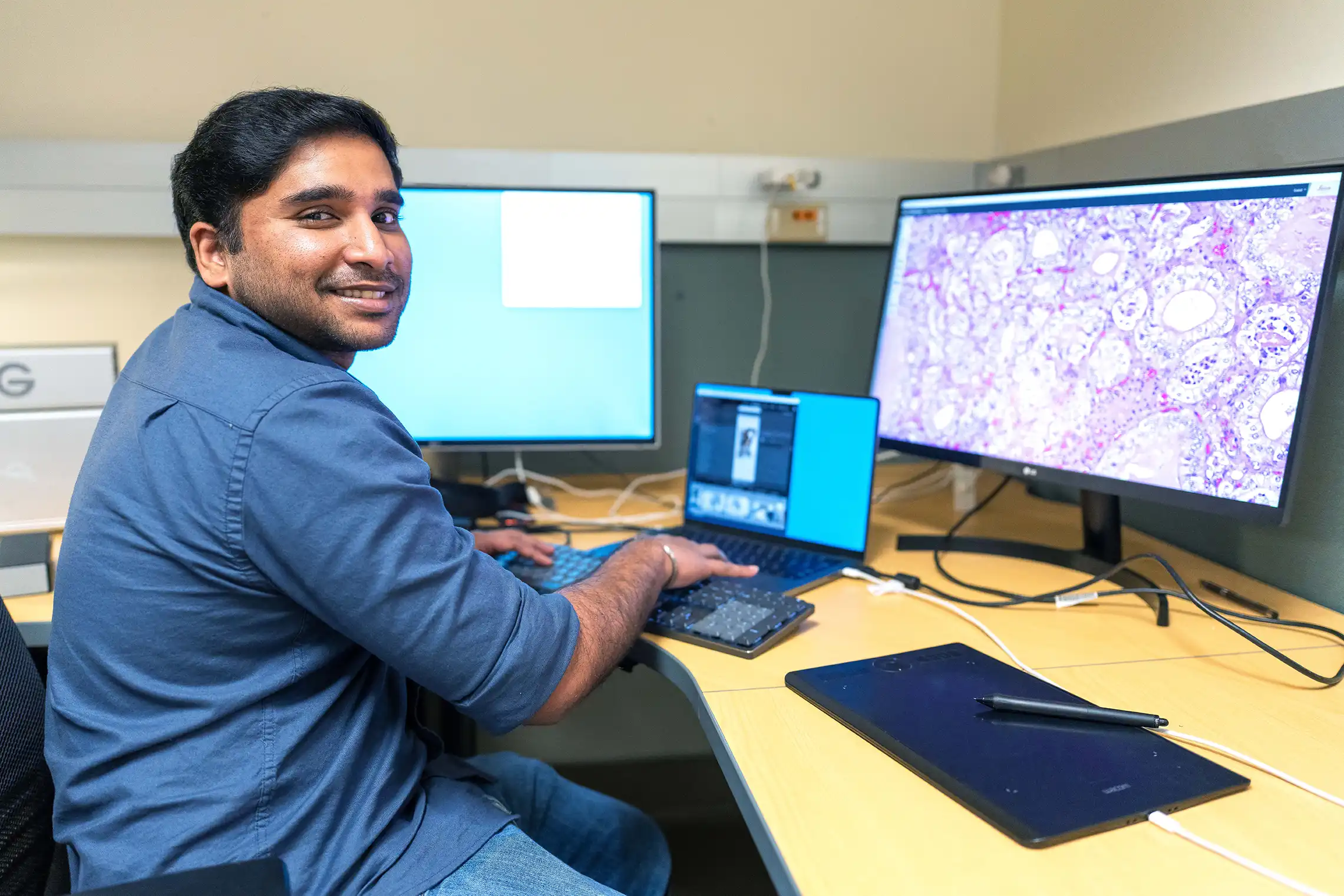
A few months before earning his doctoral degree, Akhil discovered the United States Department of Agriculture (USDA) Agricultural Research Service (ARS) Research Participation Program through the Oak Ridge Institute for Science and Education (ORISE). He had long been fascinated by the research of government agencies like USDA and the National Institutes of Health (NIH), and being a part of that research and studying pathology was something Akhil deeply desired. Though he originally had some setbacks in his search for learning opportunities, he was excited to be selected as a USDA ARS fellow.
Being selected was truly a dream come true. Suddenly the setbacks and struggles had meaning, and I was able to turn disappointment into an opportunity that placed me at the forefront of research I had always wanted to pursue,” said Akhil.
The USDA ARS Research Participation Program provides opportunities for students, postgraduates, established scientists and faculty to participate in programs, projects and activities at ARS-designated facilities to help ARS solve agricultural problems of high national priority.
He became a USDA ARS fellow under the co-mentorship of Christopher Morris of the NIH and Lisa Hensley of the USDA. Here, Akhil’s research project focused on using and improving machine learning for studying the pathogenesis of infectious diseases. Specifically, using artificial intelligence (AI) to analyze histopathology slides (images of cell samples on glass slides) from nonhuman primates infected with pathogens, such as Ebola and Marburg. Traditionally these slides are examined and annotated in detail by a human to determine infection, however, by training AI to do the same, examining these slides could take much less time and potentially be just as accurate. Training AI to detect one disease may also be transferable for detecting other diseases as well.
“This project resulted in successfully trained models for hepatic structure segmentation, streamlined workflows for artificial intelligence analysis of histopathology slides and annotated datasets that continue to serve as ground truth for ongoing research,” said Akhil. “In the long term, this research lays the groundwork for extending artificial intelligence methods beyond oncology into the study of infectious diseases, a field where they have not yet been fully realized.”
The research was presented at several conferences, including the National Interagency Confederation for Biological Research (NICBR) Winter Symposium in January 2025 and the American College of Veterinary Pathologists (ACVP) Annual Conference in October 2025. Akhil’s poster won second place for the Young Investigator Award in Industrial and Toxicologic Pathology at ACVP. Akhil also co-authored a manuscript that the team hopes will be published in the Journal of Infectious Diseases.
Akhil learned a lot about AI during his fellowship and enjoyed the independence he was given to solve problems on his own, while still having access to great mentoring when guidance was needed. He considers his time with the program at the Integrated Research Facility as an amazing experience and noted how “prestigious” it was to receive the fellowship with ORISE. After it ended, he began a veterinary anatomic pathology residency at the University of California, Davis, where he continues to train under leading pathologists. His goal is to become a board-certified veterinary anatomic pathologist who specializes in comparative and nonhuman primate pathology.
The USDA ARS Research Participation Program is funded by USDA and is administered through the U.S. Department of Energy’s (DOE) Oak Ridge Institute for Science and Education (ORISE). ORISE is managed for DOE by ORAU.