


ORNL internship experience kick-starts career
Meet Josh Cunningham
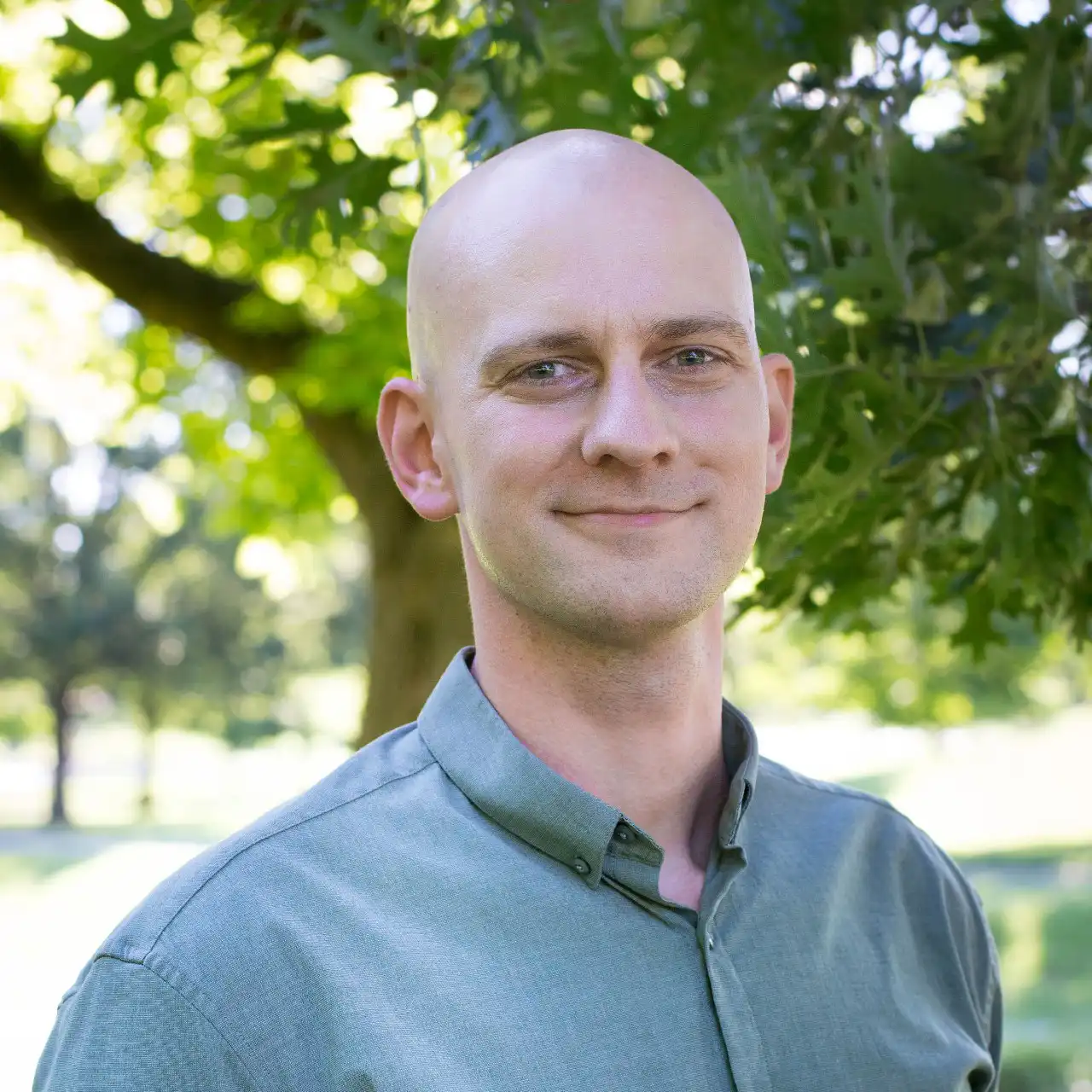
Josh Cunningham, Ph.D., a former intern at Oak Ridge National Laboratory (ORNL), is now chief operating officer for the Quantum Science Center, headquartered at ORNL. (Credit: Carlos Jones/Oak Ridge National Laboratory)
While pursuing a degree in communications at the University of Tennessee, Knoxville, Josh Cunningham, Ph.D., didn’t envision a career in STEM.
That changed with a science writing internship at Oak Ridge National Laboratory (ORNL), administered through the Oak Ridge Institute for Science and Education (ORISE).
As an intern at the ORNL-operated Oak Ridge Leadership Computing Facility (OLCF), Cunningham translated complex research — on topics like high-performance computing (HPC), quantum science and cybersecurity – into clear, engaging stories for the public.
His internship not only helped him hone his skills in science communication but also gave him a deeper understanding of how ORNL operates and supports big science at scale.
“My internship experience completely changed the direction of my career — in the best way,” he says.
Building on the foundation provided by his internship, Cunningham went on to join ORNL full time, contributing to scientific support and operational efforts that enable the laboratory’s research.
He now serves as chief operating officer for the Quantum Science Center (QSC), headquartered at ORNL. In this role, he provides operational leadership in support of the center’s research mission and cross-institutional activities.
In this Q&A Spotlight, Cunningham reflects on what the internship has meant for his career and the lessons that continue to guide his work today.
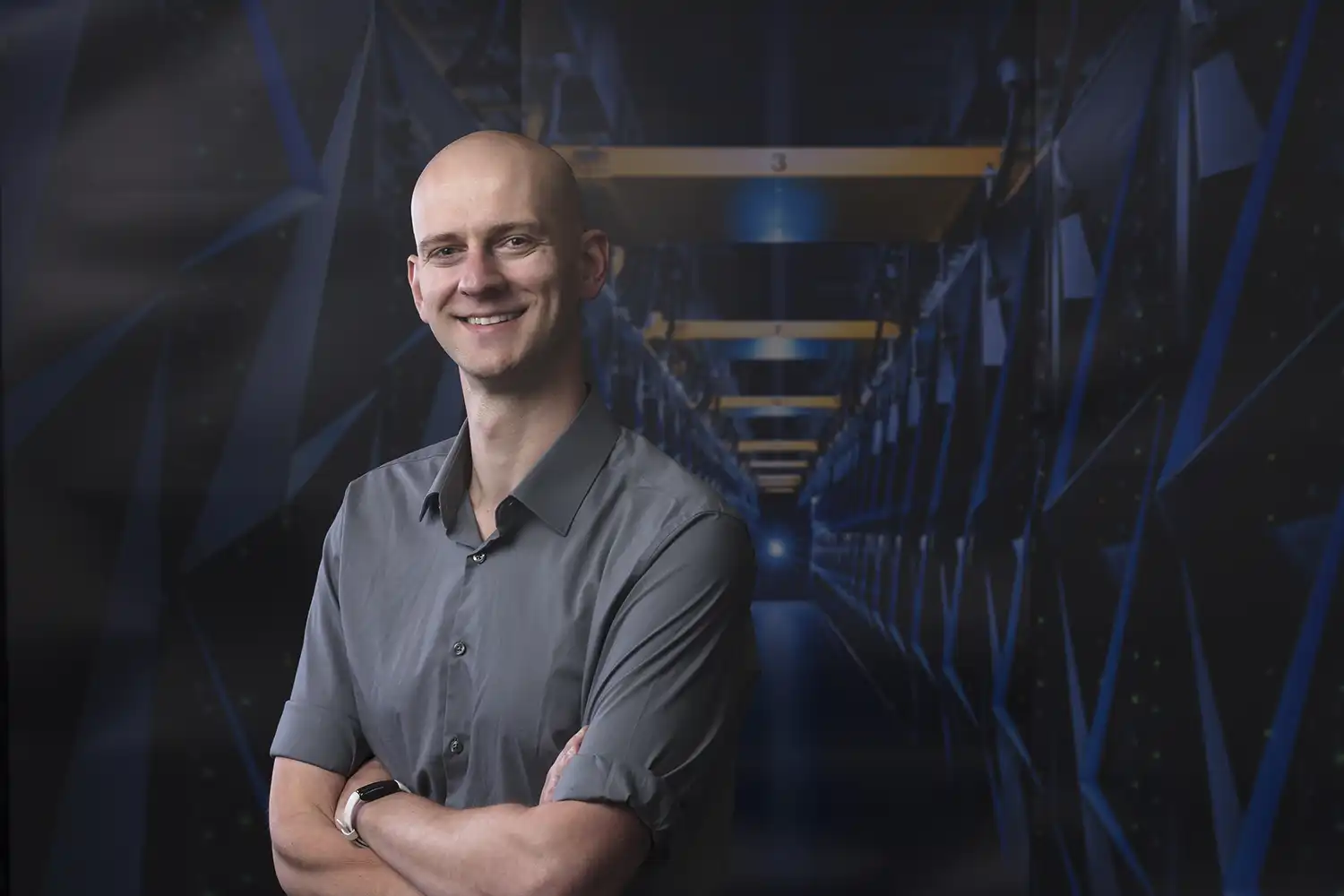
During his internship at ORNL, Cunningham honed his skills in science communication, writing about high-performance computing, quantum science and other topics. (Credit: Carlos Jones/Oak Ridge National Laboratory)
Tell us a little bit about your backstory and what motivated you to pursue a STEM career.
I never expected to pursue a career in STEM. As a communications major at the University of Tennessee, Knoxville, my path felt wide open, and not necessarily technical. That changed when I became a science writing intern at OLCF. In that role, I had the privilege of sitting down with engineers, scientists, researchers and staff to hear firsthand about the groundbreaking work they were doing.
Through those conversations, I began learning about topics I never imagined I would, including HPC, quantum science, cybersecurity and more. The more I wrote, the more curious I became, and the more I wanted to understand not just the science itself, but how these massive, complex efforts actually come together. Over time, that curiosity naturally pulled me toward the operational side of STEM: helping translate ambitious ideas into functioning programs, partnerships and systems. What started as storytelling became a career centered on enabling science at scale.
ORNL was incredibly supportive of my professional and scholarly growth throughout that journey. When I was hired as a staff member, the laboratory encouraged and supported my decision to return to graduate school, where I ultimately earned my Ph.D. in information systems and communication. That experience helped me bridge the worlds of technology, communication and organizational systems, giving me the tools to think critically about how complex scientific work is structured, communicated and sustained.
What I came to realize is that STEM is not just about equations, code or hardware — it’s also about people, collaboration, storytelling and building systems that allow innovation to thrive. My path into STEM didn’t follow a traditional trajectory, but it taught me that there’s real value in interdisciplinary thinking, and that diverse backgrounds can strengthen scientific communities.
What was the focus of your internship, and what kind of projects were you part of?
As a science writing intern, I was given the opportunity to learn how to translate complex research into clear, engaging stories for a broad audience. I wrote about scientific breakthroughs and major milestones happening at OLCF, which at the time operated both the Titan supercomputer and the newly launched Summit system. It was an exciting moment to be there — not only because of the science being done, but because I was helping tell the story of Summit’s launch. Like several OLCF systems before and after it, Summit became the world’s most powerful supercomputer at the time.
Through interviews, feature stories and project highlights, I learned how large-scale science actually happens: through teamwork, careful planning and a shared sense of purpose. My internship gave me a front-row seat to the people behind the machines and helped me see how communication plays a critical role in advancing scientific discovery.
What was the most memorable or impactful part of your internship experience?
One of the most memorable moments of my internship was the first time I sat down to interview someone on my own. I was incredibly nervous and felt completely out of my depth. I’ve experienced imposter syndrome at several points in my life, but that moment stands out as one of the most intense.
The HPC engineer I was interviewing sensed my nerves and was incredibly kind. She reminded me that everyone starts somewhere, and that learning happens “one bite at a time,” like eating an elephant. That simple metaphor stuck with me. It gave me permission to be a beginner, to ask questions, and to keep going even when I felt unsure of myself.
I still think about her words often. That conversation gave me the confidence to continue, and it shaped how I now approach new challenges — with curiosity, humility and patience for myself. In many ways, that moment set the tone for how I’ve navigated my career ever since.
How did the program challenge you or help you grow as a professional?
The biggest way the program helped me grow was by building my confidence. At a place like ORNL, it’s easy to feel overwhelmed by how much expertise exists around you. I still feel humbled by that, but my internship helped me realize that I didn’t need to know everything. I just needed to learn how I could contribute in my own way.
Through hands-on experience, mentorship and being trusted with real responsibilities, I started to see that my perspective and skills had value. The experience helped me find my voice, ask better questions and take more ownership of my work. Most importantly, it showed me that confidence comes from being willing to learn, collaborate and grow.
Were there any key lessons or skills you learned during the program that you still use today?
One of the most important skills I learned during my internship was how to communicate the mission of an organization in a way that feels clear, human and meaningful. I came to understand that it’s not enough to do important work — you also have to be able to connect with people about why it matters and help them see how it fits into the bigger picture.
How did your internship experience influence your career or academic path?
My internship experience completely changed the direction of my career — in the best way. I never would have guessed that I’d end up supporting work in areas like supercomputing and quantum science, especially coming from a social sciences background as an undergraduate. But my internship gave me my first real glimpse into the national lab environment, and I quickly realized it was a place where I wanted to grow.
Are there any mentors or colleagues from the program who have had a lasting impact on you?
My mentor during the program was Katie Bethea, group leader for User Access, Outreach and Communications. I had always enjoyed writing, but she was the first person to truly take a chance on me as a writer. She was patient, encouraging and willing to meet me where I was, while also pushing me just far enough outside my comfort zone to help me grow.
Her mentorship shaped not only my career path, but also my confidence. Years later, when I published my first book, “The AI of the Beholder: Art and Creativity in the Age of Algorithms,” Katie came to one of my book signings. It felt like a full-circle moment: Someone who believed in me before I fully believed in myself was now standing in front of me, holding a book I had written. I’m deeply grateful for the role she played in my development, and for the way she modeled what thoughtful, supportive mentorship can look like.
If you could go back and give yourself advice during your internship, what would it be?
I would tell myself to be patient. You don’t have to walk into an organization knowing everything, and you certainly don’t have to have your entire career mapped out. It’s good to have ideas and aspirations, but it’s also OK to let your path unfold.
If you stay curious, work hard and remain open to learning, opportunities have a way of finding you —and shaping you in ways you can’t always predict. Looking back, I wish I had spent less time worrying about whether I was “on the right track” and more time trusting that growth happens one step at a time.
Looking back on your experience, how would you describe the overall impact and benefits of participating in this program, both personally and professionally?
It’s hard to put into words, but the impact of this experience went far beyond helping my career — it opened up an entirely new world for me. I’ve always been someone who didn’t quite know what I wanted to be “when I grew up,” and I often felt unsure about where I fit. This internship didn’t just give me direction; it gave me possibility.
It introduced me to a space I never knew I could belong in, helped me see my strengths more clearly and showed me that careers don’t always follow straight lines. Personally, it gave me confidence and curiosity. Professionally, it gave me a foundation, a network and a sense of purpose. It truly shaped the way I think about my work and myself.
What do you like to do outside of STEM (hobbies, activities, interests, etc.)?
Outside of STEM, I really enjoy creative outlets like writing for fun and making music. I’ve been producing electronic music for years under the name Mystery Mammal, and creativity has always been an important way for me to recharge.
The ORNL Educational Programs are managed by the ORNL Office of Research Education (ORE) and administered by the Oak Ridge Institute for Science and Education (ORISE). For more information about available programs at ORNL, please visit education.ornl.gov.